
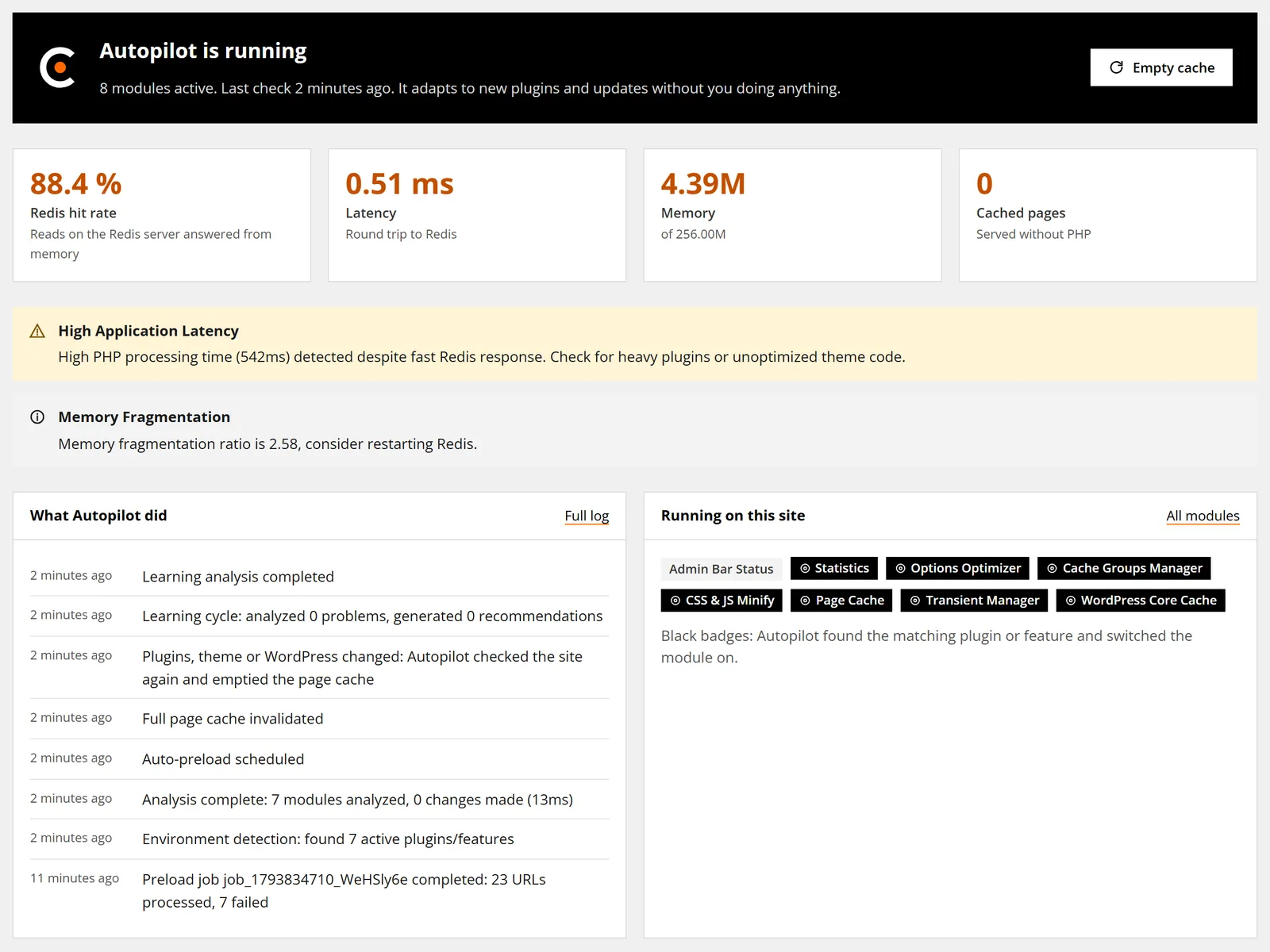
Object cache
Redis object cache for WordPress, with a fallback for outages
CachePilot replaces object-cache.php with its own drop-in. Queries, options and transients come from Redis instead of MySQL. If Redis stops answering, the site keeps running from the database and the drop-in tries again after 30 seconds.
What the Statistics page tells you
Open a numbered point to read what it shows. On small screens the notes follow the image as a list.
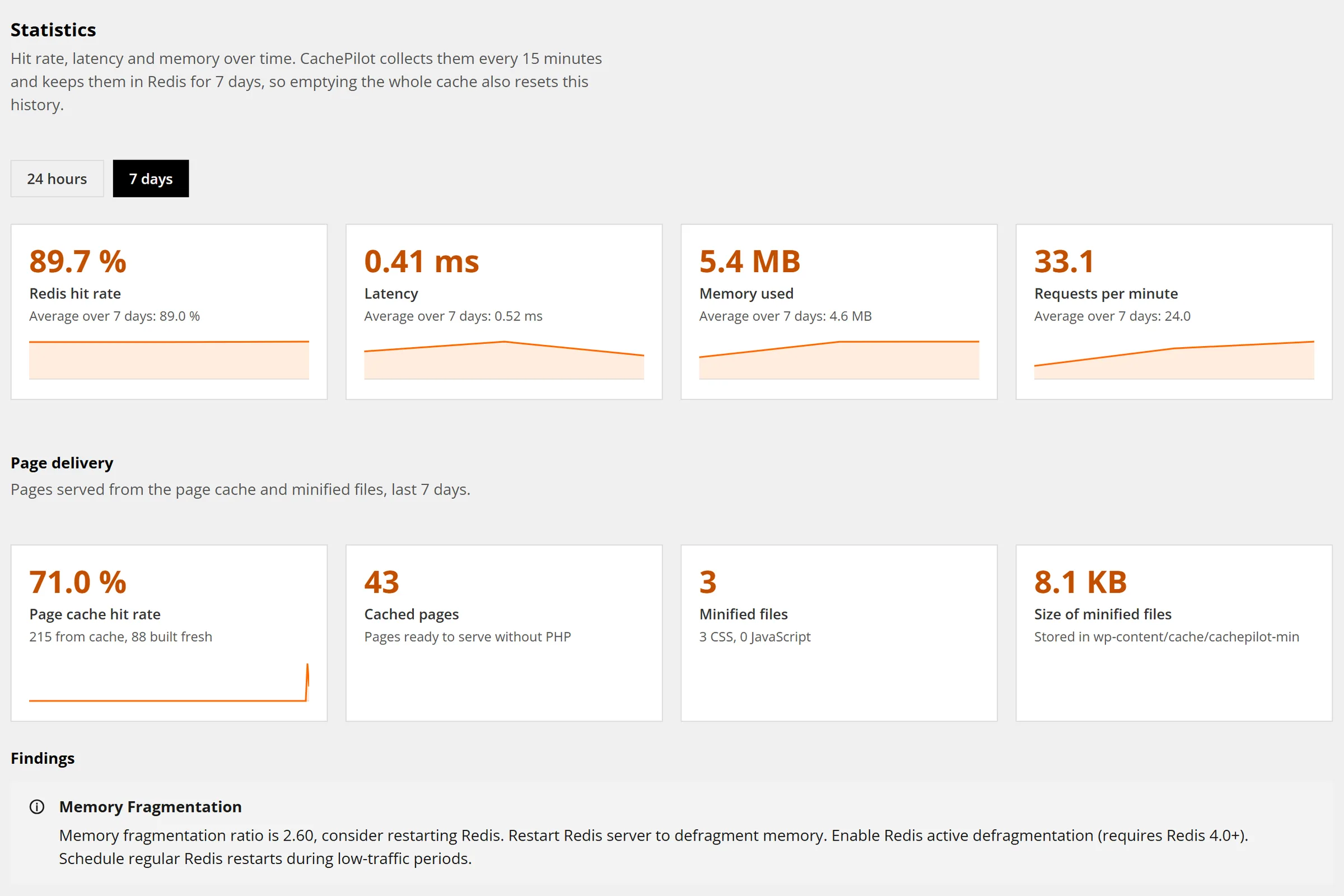
Hit rate
The share of cache reads Redis answered. A low rate after a flush is normal and climbs with the next page views.
Latency
How long Redis takes to answer, read once per request together with status and INFO.
Memory
Memory used by Redis. The hourly check of Autopilot warns when it is full.
Page delivery
Page cache and minify figures for the last seven days, built from hourly aggregates.
What the drop-in does on every request
Six details that decide how many round trips a page costs.
Prefetch of known keys
CachePilot records which keys a page used and loads them on the next request in two pipelined calls.
Options in one hash
All autoloaded options sit in one Redis hash that the drop-in maintains.
No second question
Keys Redis reported missing are not asked for again in the same request.
Persistent connection
The connection stays open between requests. Deferred writes are used only for query caches.
TLS to Redis
TLS with certificate verification switched on by default, set under CachePilot, Settings, Connection.
Shared databases
Every key carries a prefix. When CachePilot finds keys of other applications, flushes stay within its own prefix.
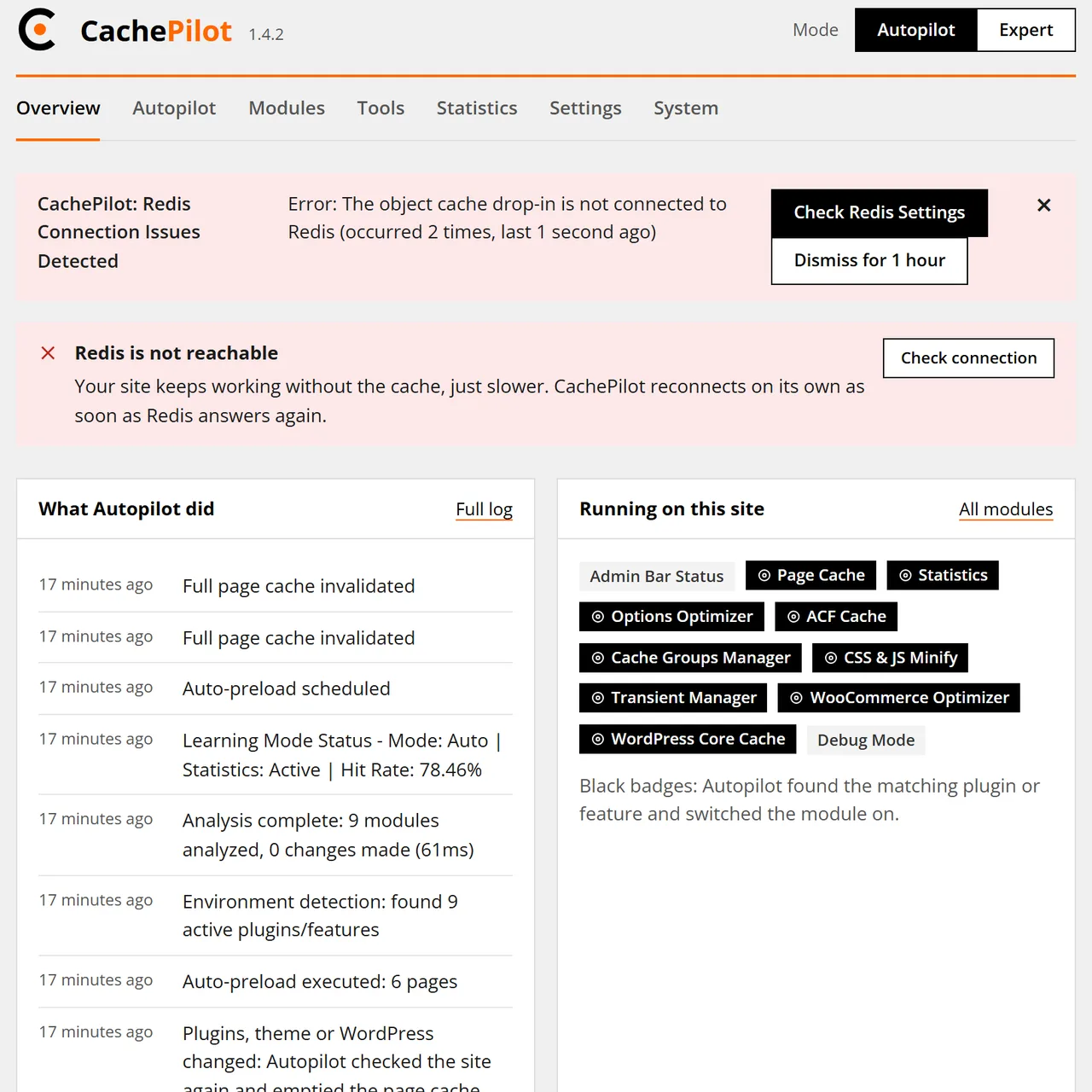
When Redis fails
An outage of Redis costs one timeout, not one per cache call.
The connect timeout is 1 second. After a failed connection the drop-in skips Redis for 30 seconds, and WordPress reads from MySQL as it would without a cache.
When Redis is back, the cache is emptied once, so no page is built from stale data.
Questions about the object cache
More answers are in the FAQ of the documentation.
Can several sites share one Redis server?
Yes. CachePilot puts a prefix in front of every key. When it finds keys of other applications in the same database, it limits flushes to its own prefix.
Does CachePilot support Redis Cluster or Sentinel?
No. CachePilot connects to one Redis server, over TCP, TLS or a Unix socket.
Which wp-config constants does CachePilot read?
WP_REDIS_HOST, WP_REDIS_PORT, WP_REDIS_PASSWORD, WP_REDIS_DATABASE, WP_REDIS_PREFIX, WP_REDIS_TIMEOUT, WP_REDIS_SCHEME and WP_REDIS_SSL_CONTEXT.
How do I check that the cache works?
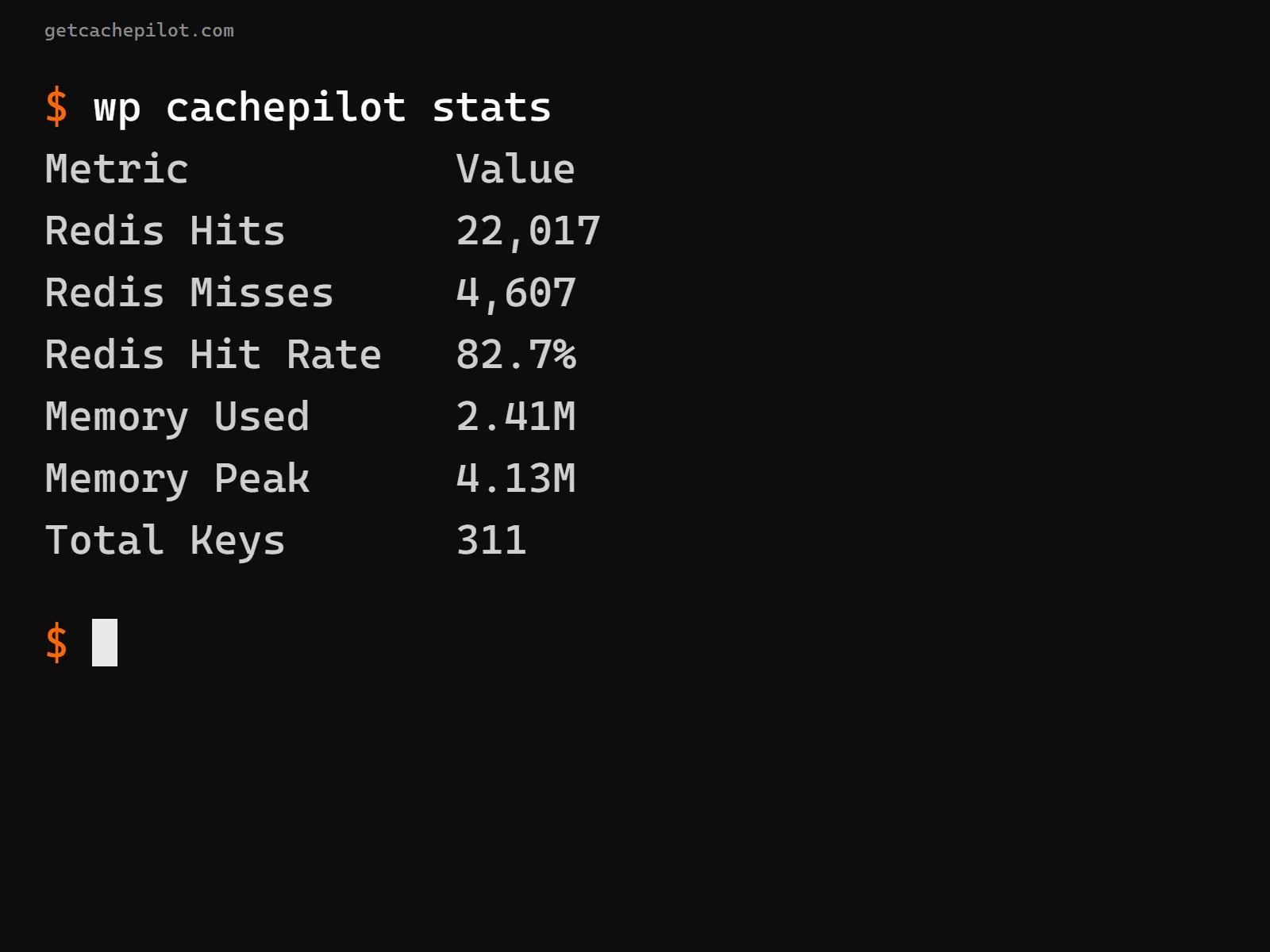
Open CachePilot, Overview for hit rate, latency and memory, or run wp cachepilot test.
What happens to the cache when I deactivate CachePilot?
Deactivation and uninstall remove the keys of CachePilot from Redis, so no stale data is left behind.
Beta
Measure it on your own site.
Install CachePilot during the beta and compare the Overview before and after. Our own figures are on the benchmarks page.