
CachePilot is a Redis object cache for WordPress that configures itself. Its first commit in the current repository, 6735cf9, is dated 9 February 2026 and was written by Patrick Schlesinger of CMS ADMINS. It brought plugin version 1.0.2 with 19 module folders, 204 PHPUnit tests and a complete development environment in Docker.
This post looks back at that starting point. It describes what the code contained on that day, based on the commit itself and the changelog in readme.txt. It does not describe the plugin as it works today; for that, see Autopilot and the changelog.
Why build another object cache for WordPress?
A persistent object cache keeps the results of database queries in Redis, so WordPress does not run the same query on every request. The common plugins for this leave the decisions to the site owner: which cache groups to keep, how long, and which plugin needs special handling. On sites with WooCommerce, WPML or ACF those decisions are where most of the work and most of the errors lie.
CachePilot was started to take those decisions over. The plugin detects which plugins a site runs, loads a module for each of them and sets cache groups and lifetimes on its own. That idea is what the two modes of the first version are about.
What was in the first commit?
Commit 6735cf9 added 209 files at once. The plugin header names version 1.0.2. The main parts were:
- Two modes. In Autopilot mode the plugin chooses modules and settings itself. In Expert mode the site owner switches modules and values by hand.
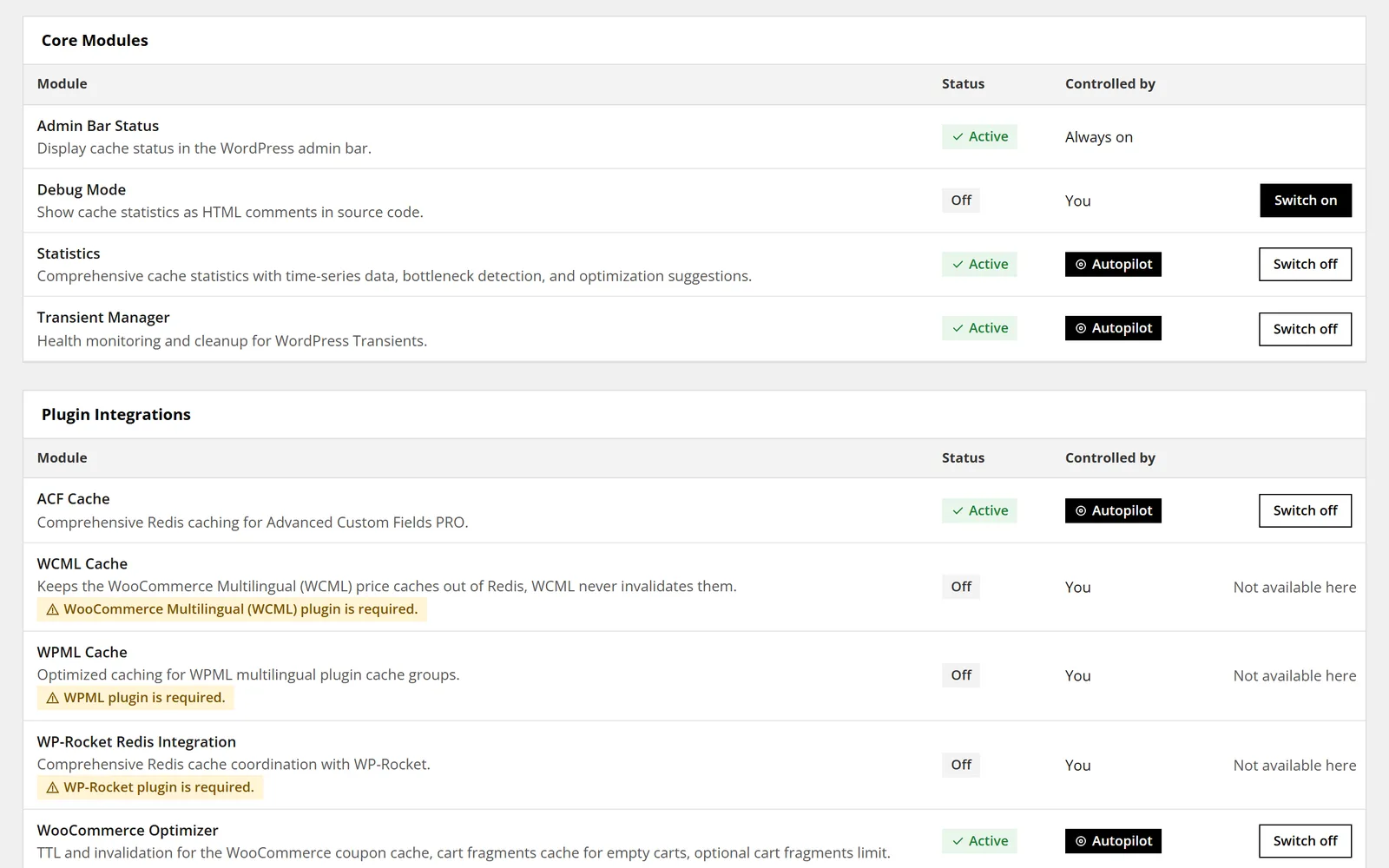
- 19 module folders: ACF, AdminBar, Autopilot, CacheGroups, Debug, Elementor, Jetpack, Multisite, Options, PageCache, Statistics, TLS, Transients, WCML, WPML, WPRocket, WooCommerce, WordPressCore and Yoast.
- A full page cache in the PageCache module, next to the object cache drop-in.
- WP-CLI commands for status, flushing and the drop-in.
- TLS for the connection to Redis, at that time as a module of its own.
- 204 PHPUnit tests in tests/Unit, one test class per module and further tests for configuration, drop-in configuration and the Autopilot log.
The development environment
The same commit set up a Docker stack, so every change could be tested against a real WordPress with a real Redis server: WordPress 6.7 with PHP 8.3 and Apache, Redis 7, MariaDB 11, and a separate container for benchmarks. The WordPress image compiles phpredis with igbinary and lzf support. A second compose file runs the same stack in CI.
wp cachepilot status
wp cachepilot flush
wp cachepilot dropin installWhat came before February 2026?
Versions 1.0.0 and 1.0.1 were made before February 2026. They have no commit in this repository, so there is no date we can prove. The changelog records them as follows:
- 1.0.0: initial release with 18 optimization modules, Autopilot and Expert modes, full page caching, WP-CLI integration and TLS/SSL support.
- 1.0.1: asynchronous preloading of the page cache through WP Cron, atomic writes of the configuration, key counting with Redis SCAN, a fallback for sys_getloadavg() on Windows, a log of every Autopilot action, and the removal of the early_exit features for security reasons.
Version 1.0.2, the state of the first commit, added the WordPress Core module, the WPML and WCML modules, the coupons cache group for WooCommerce, and let the learning system apply its recommendations to all registered cache groups.
What happened next?
After a second commit on the same day, which made the scripts work with Git Bash on Windows, the repository was quiet until November 2026. Then the plugin was rebuilt in three days, from 19 to 15 modules and from about 54,500 to 24,250 lines of code. The history of CachePilot tells that part.
To try the current version, join the beta and follow getting started.
Sources
- Commit 6735cf9 “Initial dev environment setup”, 9 February 2026, Patrick Schlesinger: 209 files, cachepilot.php with Version 1.0.2, folder modules/ with 19 subfolders, tests/Unit with 204 test methods.
- docker/docker-compose.yml and docker/Dockerfile.wordpress in commit 6735cf9: images wordpress:6.7-php8.3-apache, redis:7-alpine, mariadb:11.
- Commit e67d913, 9 February 2026: Windows and Git Bash compatibility for scripts and Docker tooling.
- plugin/readme.txt, changelog entries 1.0.0, 1.0.1 and 1.0.2.